
The World Cup Has Arrived, but Most Americans Aren’t in the Game Yet



Omnibites are bite-sized insights from the AmeriSpeak Omnibus, NORC’s fast, affordable way to tap into nationally representative public opinion.
June 2026
New AmeriSpeak Omnibus data show limited U.S. engagement with the 2026 FIFA World Cup, revealing clear opportunities to build awareness, interest, and momentum.
The 2026 FIFA World Cup is underway in North America, but for many in the United States, it’s not a front-of-mind moment. The top international football (soccer) tournament crowns the men’s world champion every four years. It is also the most-watched sporting event globally.
New insights from the AmeriSpeak® Omnibus reveal that engagement remains limited in the United States, with only about 1 in 3 adults familiar with, interested in, or planning to watch the tournament. Beneath that headline lies a more nuanced story: who is in the game, where momentum is building, and where brands and communicators have the most opportunity to connect.
How interested are Americans in the FIFA World Cup?
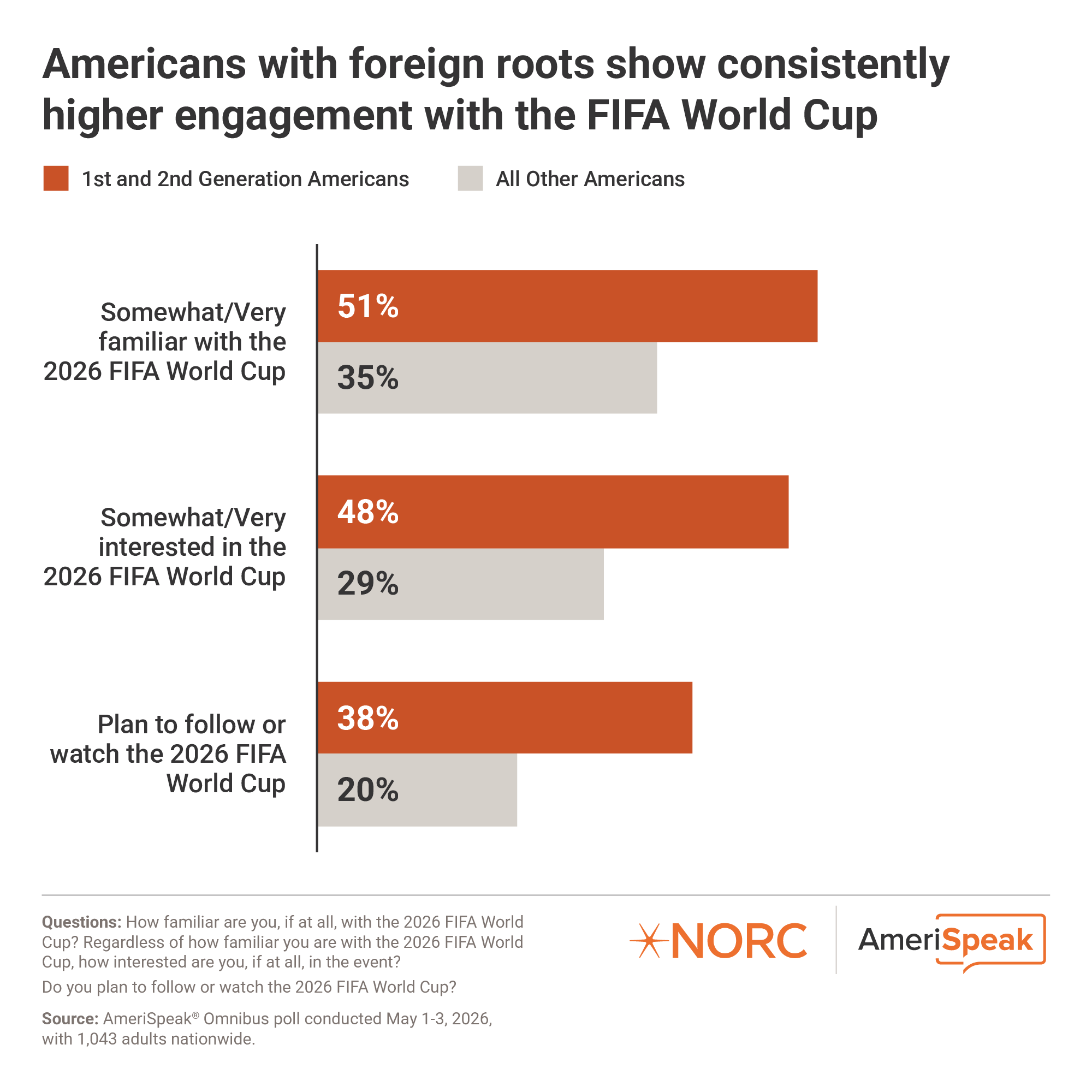
The world’s largest international soccer tournament is massively popular globally but still building awareness in the United States. Across three measures (familiarity, interest, and intent to watch), a new survey shows that only about 1 in 3 Americans report meaningful engagement overall.
Whichever way you look at it, broad U.S. engagement still has room to grow. For brands and communicators, that’s both a reality check and an opportunity: there’s plenty of open field to build relevance in 2026 and beyond.
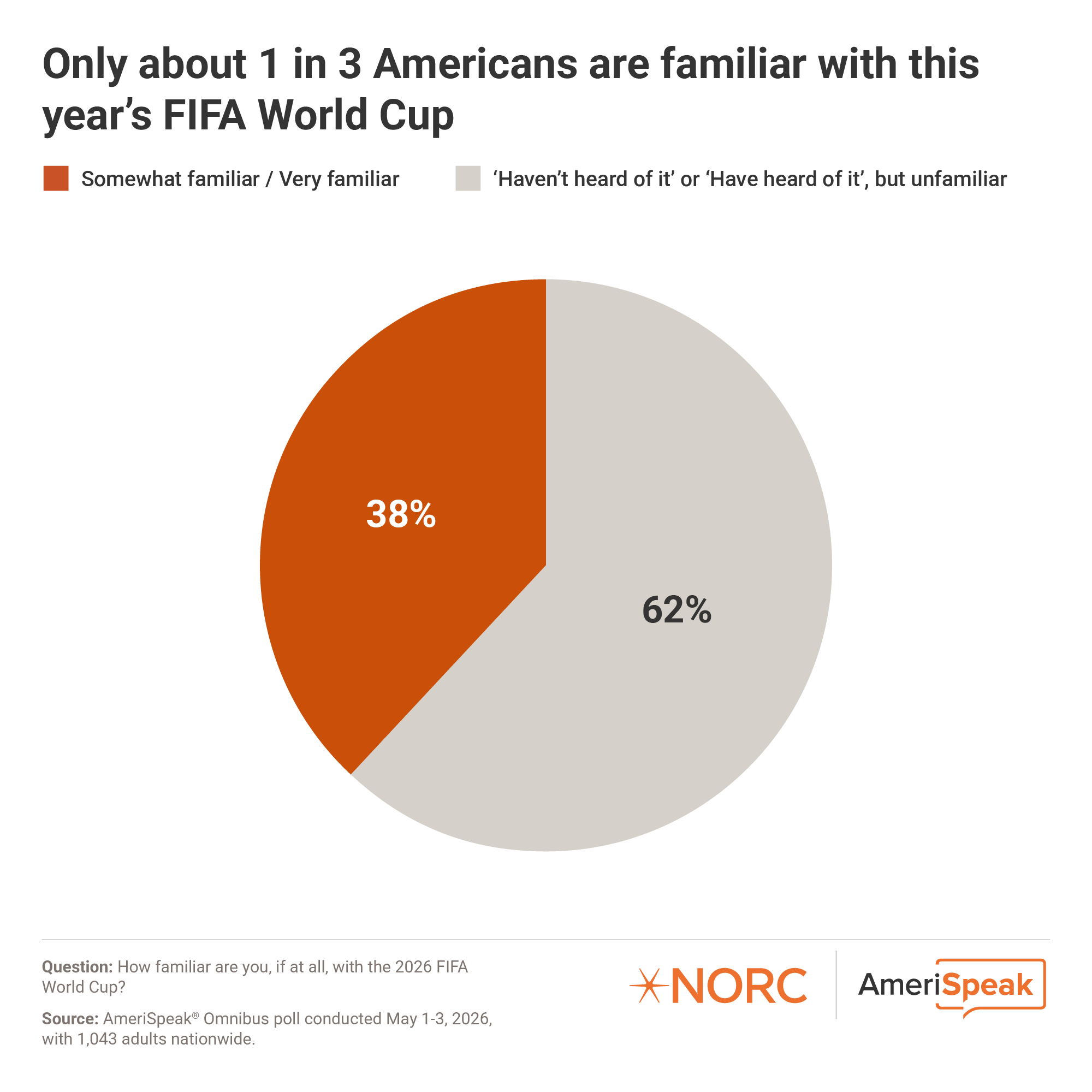
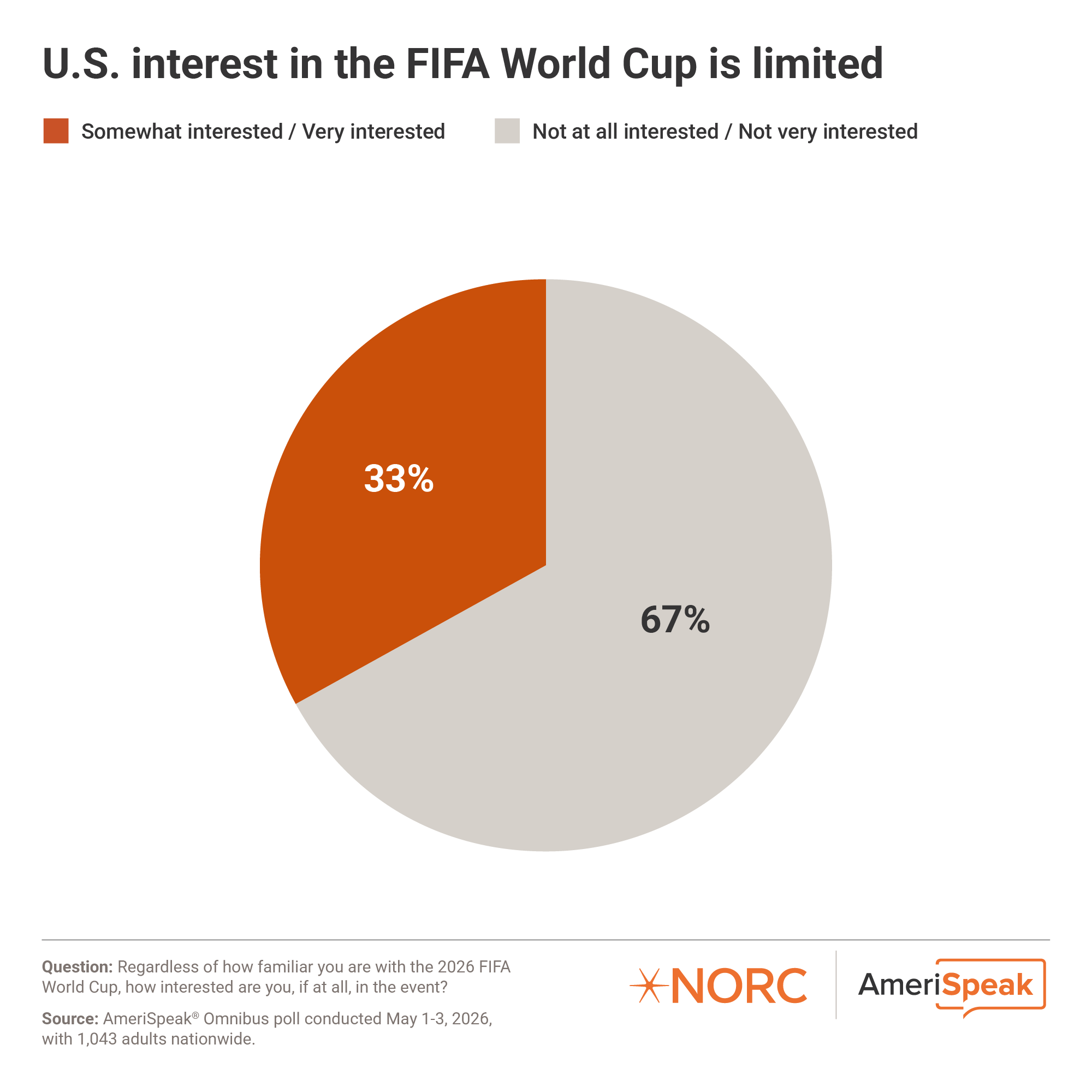
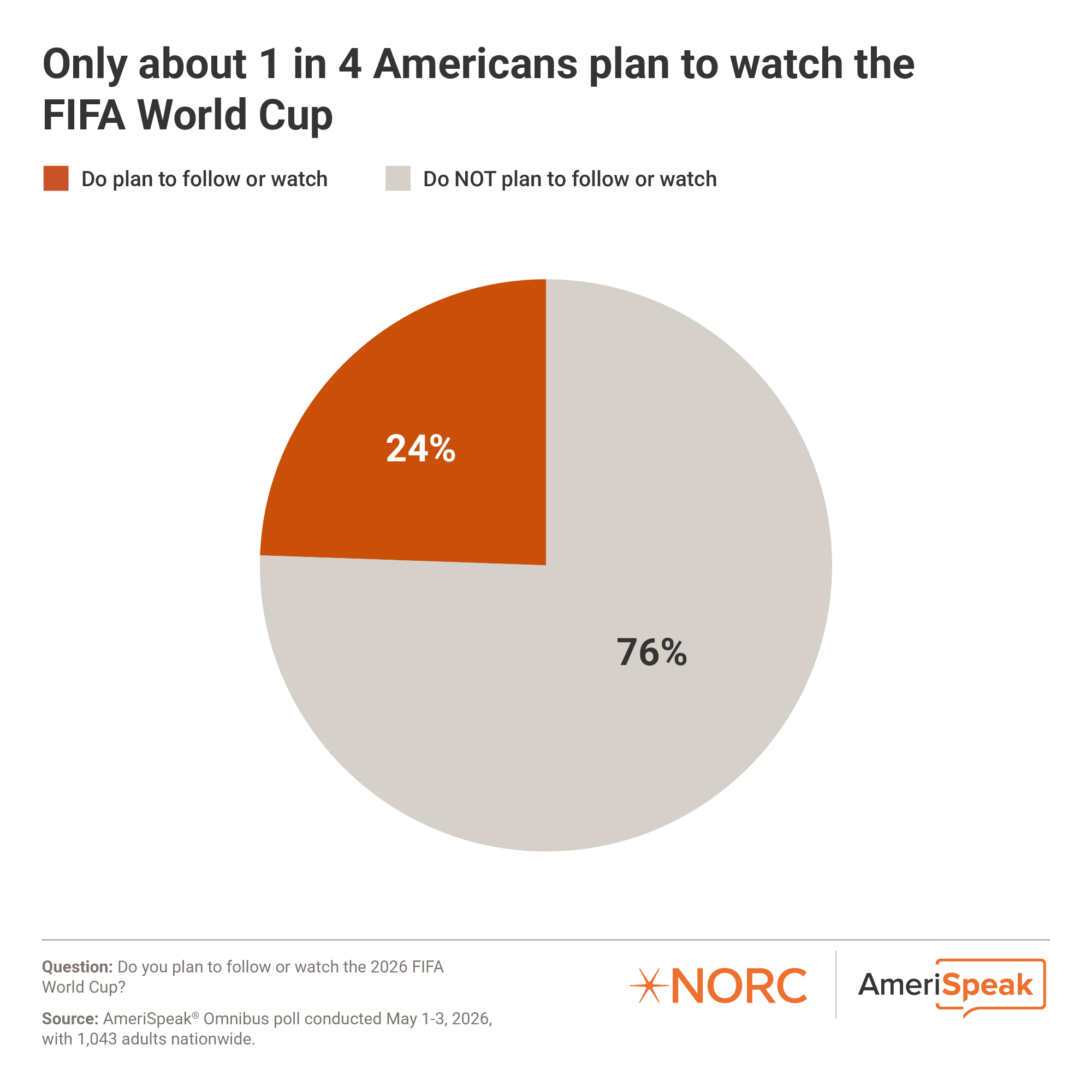
In the United States, engagement with the world’s largest international soccer tournament tracks closely with cultural background.
First- and second-generation Americans are far more likely to be familiar with, interested in, and planning to watch the World Cup. The pattern is consistent across every measure we tracked—from familiarity to viewing intent.
For many globally connected communities, the World Cup isn’t just a sporting event—it’s a shared ritual rooted in identity, history, and national pride.
Findings are drawn from our AmeriSpeak Omnibus survey, which offers a streamlined, cost-effective solution for obtaining high-quality, nationally representative data.
Is soccer a wealthy person’s sport in the United States?
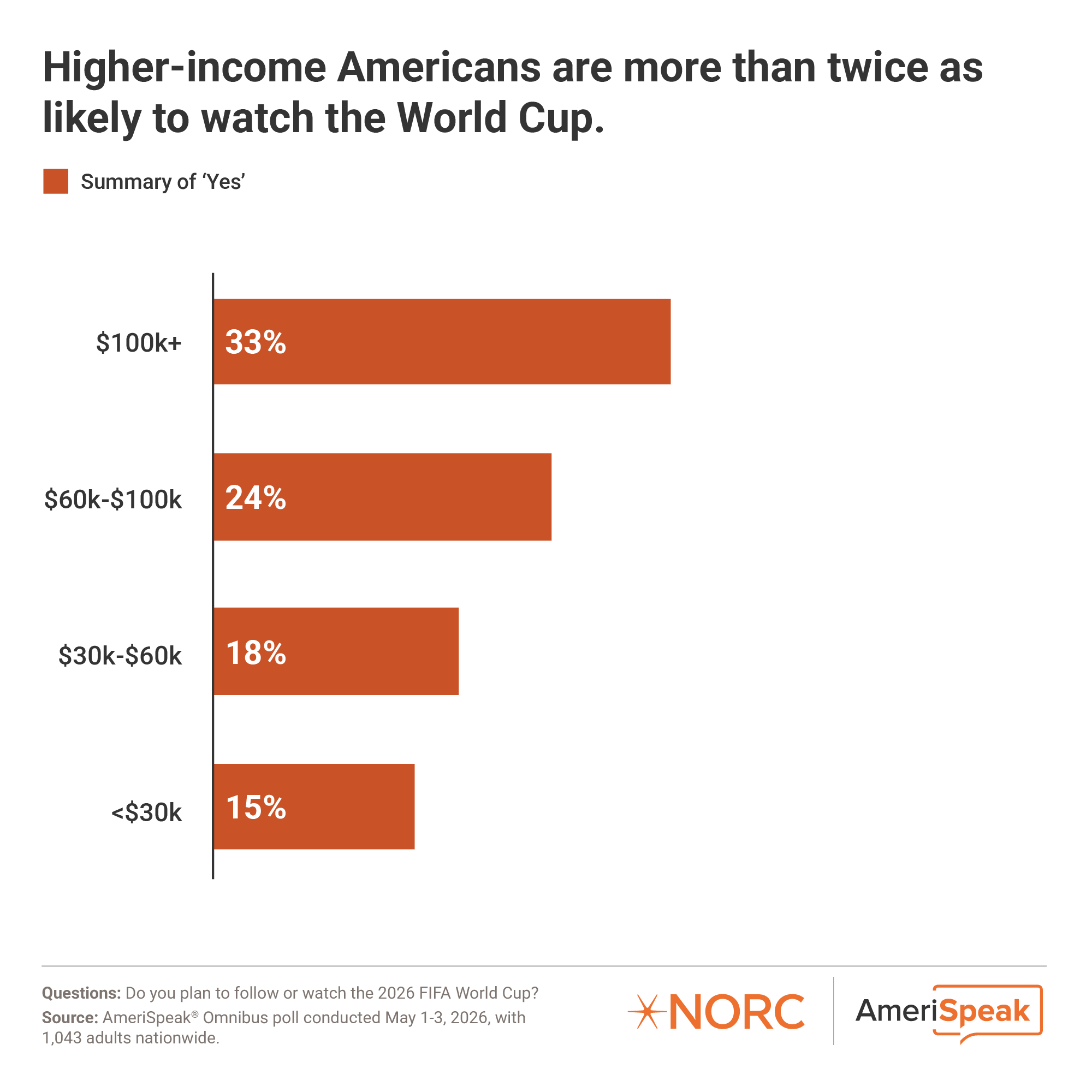
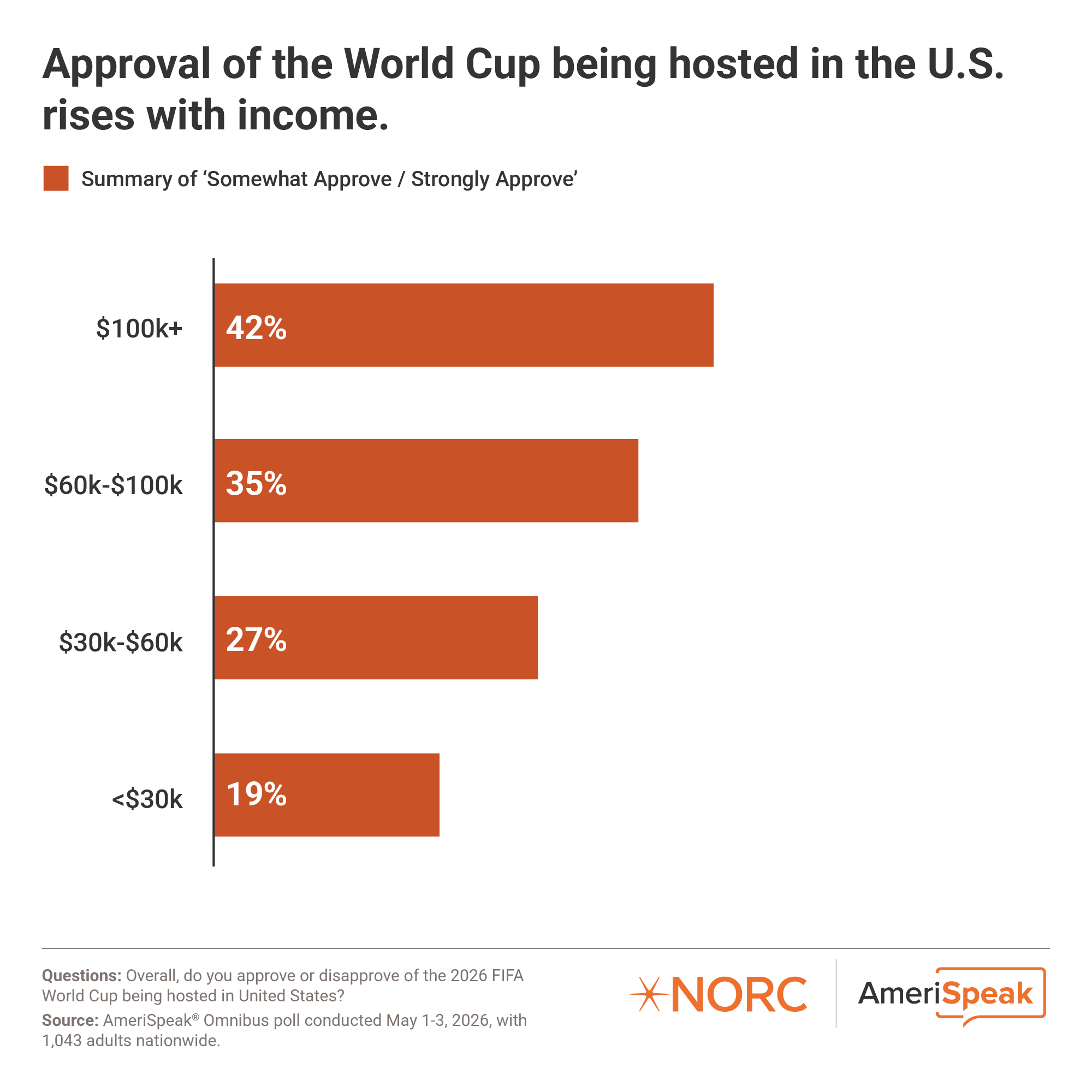
Data on FIFA World Cup approval and viewing suggest engagement with the sport’s biggest global event rises with income. Higher-income Americans are more positive in how they feel about the tournament being hosted in the Unites States and more likely to watch.
About one-third (33 percent) of Americans earning $100K+ say they plan to watch or follow the World Cup—more than double the share of those earning under $30K (15 percent). Approval of the Cup being hosted in the United States follows a similar pattern, rising from 19 percent among the lowest-income group to 42 percent among the highest.
If approval and viewership are strongest among higher-income Americans, the question becomes: in the United States, who feels like the game is “for them”? A 2026 RWJF study of adult sports fans, fielded on the AmeriSpeak panel, finds that most World Cup fans first connect to sports through playing when they’re younger and remain closely tied to youth sports. This could correlate to broader conversations about access to the sport, including the rising cost of youth participation.
Where Engagement Is Already Strong: AANHPI Communities
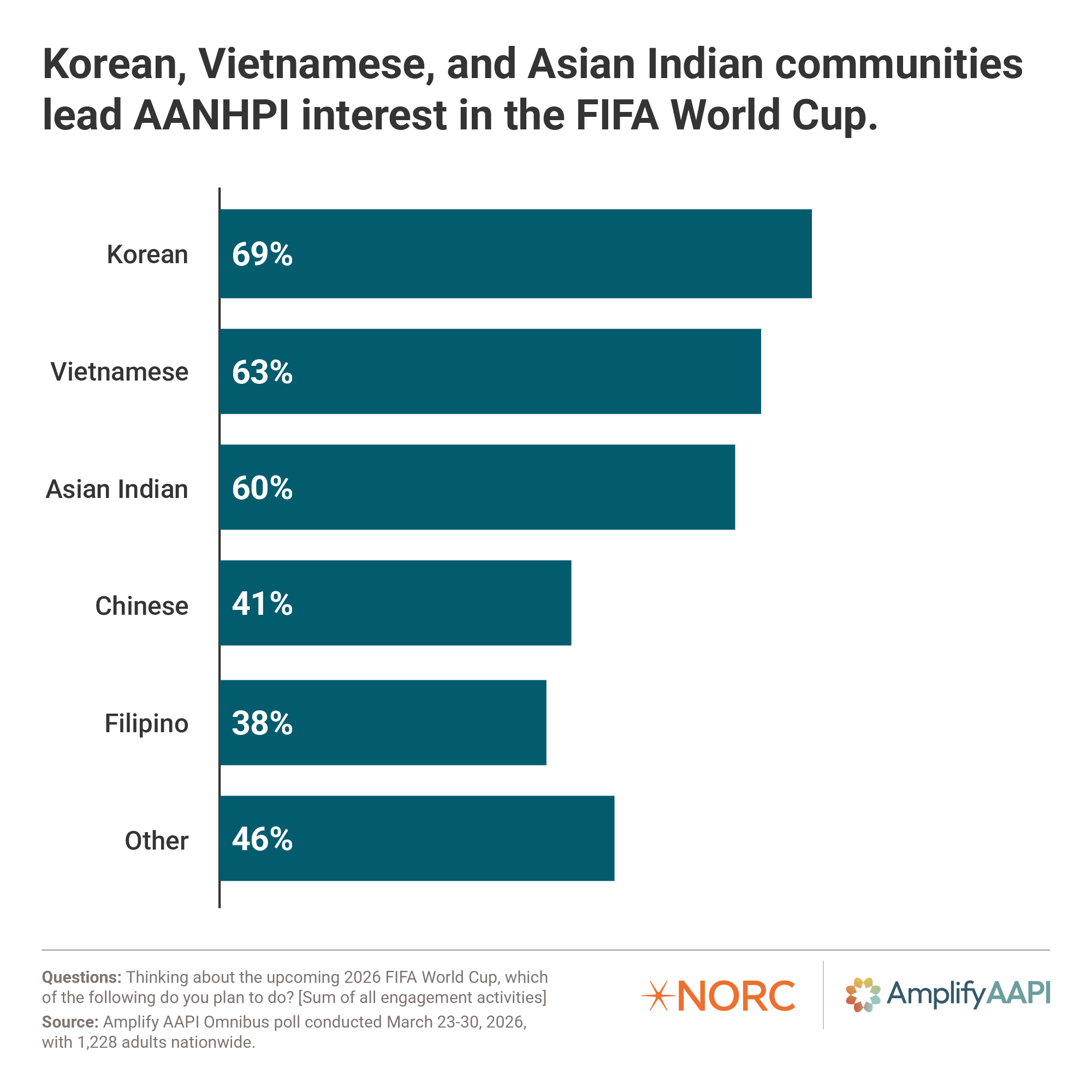
While overall U.S. engagement is still building, some communities are already more deeply connected to the World Cup.
New insights from Amplify AAPI—powered by AmeriSpeak— show that enthusiasm varies widely across Asian American, Native Hawaiian, and Pacific Islander (AANHPI) communities, with especially high engagement among Korean (69 percent), Vietnamese (63 percent), and Asian Indian (60 percent) Americans.
These differences highlight an important takeaway: World Cup fandom isn’t just driven by access or marketing, it’s shaped by cultural connection.
These findings point to a wide-open field. While broad awareness and enthusiasm are still developing, specific audiences, such as globally connected communities, younger adults, and higher-income consumers, are already moving closer to kickoff. For organizations looking to show up in 2026, the opportunity isn’t just to tap into existing excitement. It’s to help create it.
Methodology
A poll of 1,043 American adults was conducted between May 1-3, 2026, using the AmeriSpeak® Omnibus, a bi-monthly multi-client survey using the AmeriSpeak panel, NORC’s probability-based panel that is designed to be representative of the U.S. household population. The margin of error is +/- 4.0 percentage points at the 95 percent confidence level, including the design effect. View the full methodology in the Transparency Report.
Findings are drawn from our AmeriSpeak Omnibus survey, which offers a streamlined, cost-effective solution for obtaining high-quality, nationally representative data. The Omnibus provides a nationally representative snapshot of U.S. adults, sourced directly from the AmeriSpeak panel. Households are selected randomly through NORC’s National Sample Frame, known for its industry-leading coverage. This frame encompasses over 97 percent of U.S. households, ensuring that all segments are well represented. AmeriSpeak goes the extra mile in recruitment, using a combination of U.S. mail notifications, NORC telephone interviewers, and in-person field staff.
Get in touch with our team and find out how our Omnibus—or any of our other survey options—can meet your research needs.
AmeriSpeak OmniBites
Bite-sized insights from the AmeriSpeak Omnibus. The Omnibus is a fast, affordable way to tap into nationally representative public opinion.
About AmeriSpeak
Funded and operated by NORC at the University of Chicago, AmeriSpeak® is a probability-based panel designed to be representative of the U.S. household population. Randomly selected U.S. households are sampled using area probability and address-based sampling, with a known, non-zero probability of selection from the NORC National Sample Frame. These sampled households are then contacted by U.S. mail, telephone, and field interviewers (face-to-face). The panel provides sample coverage of approximately 97 percent of the U.S. household population. Those excluded from the sample include people with P.O. Box only addresses, some addresses not listed in the USPS Delivery Sequence File, and some newly constructed dwellings. While most AmeriSpeak households participate in surveys by web, non-internet households can participate in AmeriSpeak surveys by telephone. Households without conventional internet access but having web access via smartphones are allowed to participate in AmeriSpeak surveys by web. AmeriSpeak panelists participate in NORC studies or studies conducted by NORC on behalf of governmental agencies, academic researchers, and media and commercial organizations.
For more information, email AmeriSpeak-BD@norc.org or visit AmeriSpeak.norc.org.
About NORC at the University of Chicago
NORC at the University of Chicago conducts research and analysis that decision-makers trust. As a nonpartisan research organization and a pioneer in measuring and understanding the world, we have studied almost every aspect of the human experience and every major news event for more than eight decades. Today, we partner with government, corporate, and nonprofit clients around the world to provide the objectivity and expertise necessary to inform the critical decisions facing society.
Contact: For more information, please email press@norc.org or call (877) 832-0392.


