
Why Crowd Size Estimates Often Miss the Mark



Omnibites are bite-sized insights from the AmeriSpeak Omnibus, NORC’s fast, affordable way to tap into nationally representative public opinion.
June 2026
When large public events make national headlines, attendance figures quickly become a primary focus.
Attendance estimates influence debate and downstream decisions. But what’s less visible is how easily survey-based turnout numbers can be distorted by design choices most survey buyers never think about.
A recent survey from AmeriSpeak®, run on the AmeriSpeak Omnibus, indicates that approximately three percent of U.S. adults, about eight million people, attended nationwide No Kings Rallies on March 28. What makes that estimate notable is not just the size of the turnout, but how it was measured.
Because attendance can be interpreted in multiple ways, surveys are particularly susceptible to overstatement. This is especially true when question structure, definitions, or sample composition aren’t handled carefully. This case highlights two common sources of error that can silently undermine otherwise credible-looking estimates.
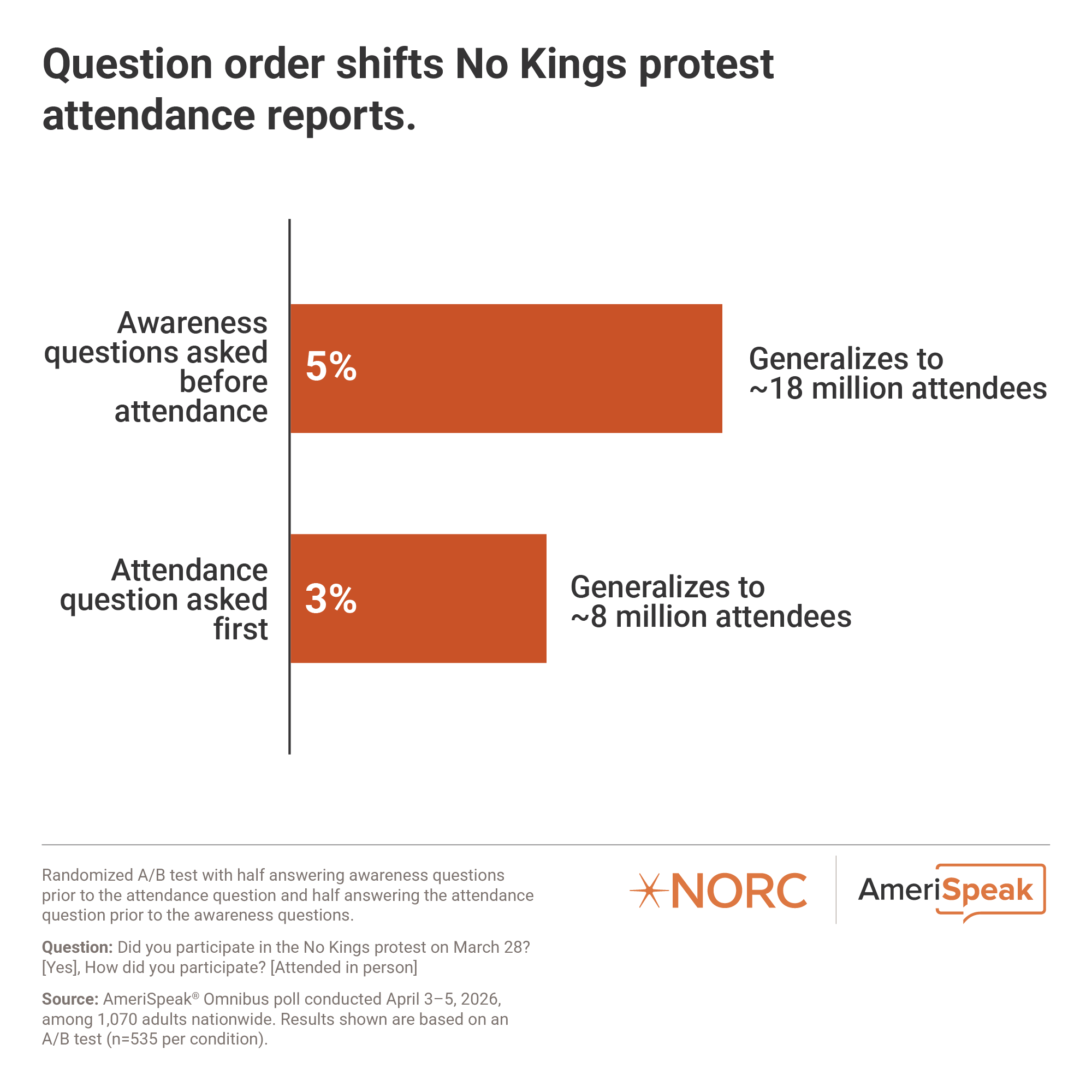
Question order shifts No Kings protest attendance reports.
The version that primed respondents produced higher reported turnout—consistent with decades of survey research on contextual effects.
This reflects how respondents process meaning. When surveys ask for opinions before asking about actions, people may apply broader interpretations to what “attendance” includes or feel more inclined to associate themselves with an event.
At the population level, even small shifts like this can translate into under or overreporting millions of people in attendance estimate.
Findings are drawn from our AmeriSpeak Omnibus survey, which offers a streamlined, cost-effective solution for obtaining high-quality, nationally representative data.
Silent Error: “Participation” Is Not the Same as Attendance
A second source of overestimation comes from how questions are phrased. In this case, it is how panelists define participation.
When respondents in the AmeriSpeak survey initially reported that they “participated” in one of the nationwide No Kings Rallies, follow-up questions revealed something important: nearly one-quarter reported not attending an in-person march at all.
Instead, this segment viewed participation as including:
- Watching news coverage
- Engaging online
- Attending small or private gatherings
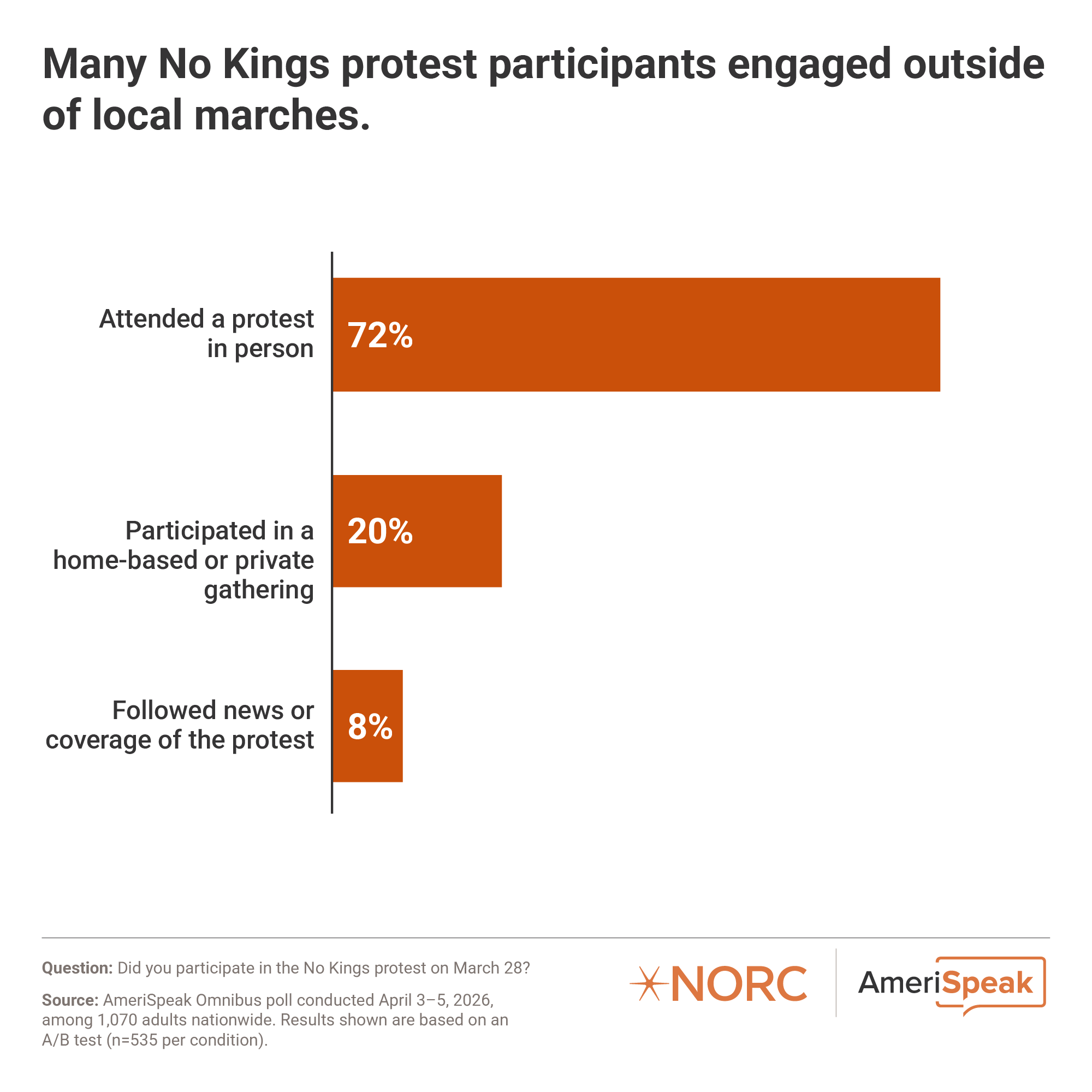
Many No Kings protest participants engaged outside of local marches.
Without clarification, surveys can unintentionally conflate symbolic engagement with physical presence, producing inflated turnout estimates that don’t align with the question decision-makers care about most—in-person attendance.
Clear definitions, follow-up validation, and disciplined question design are essential when measuring behavior that can be interpreted in multiple ways.
What This Means for Researchers
Estimating attendance isn’t about a single design decision. It’s about understanding where surveys quietly fail—and building a methodology that anticipates and manages those risks.
Mitigating these risks is always important, but it becomes especially critical when estimates are large, newsworthy, or historically significant. In those moments, methodology can’t be a footnote. It has to be the foundation.
AmeriSpeak brings that foundation together through probability-based sampling, disciplined questionnaire design, and sustained nonresponse follow up. This approach produces scientifically rigorous estimates that decision-makers can stand behind, whether participation is modest or unusually high.
When accuracy matters, the most important questions are often the ones you didn’t realize needed to be asked.
Methodology
A poll of 1,070 American adults was conducted between April 3-5, 2026, using the AmeriSpeak® Omnibus, a bi-monthly multi-client survey using the AmeriSpeak panel, NORC’s probability-based panel that is designed to be representative of the U.S. household population. The margin of error is +/- 4.0 percentage points at the 95 percent confidence level, including the design effect. View the full methodology in the Transparency Report.
Findings are drawn from our AmeriSpeak Omnibus survey, which offers a streamlined, cost-effective solution for obtaining high-quality, nationally representative data. The Omnibus provides a nationally representative snapshot of U.S. adults, sourced directly from the AmeriSpeak panel. Households are selected randomly through NORC’s National Sample Frame, known for its industry-leading coverage. This frame encompasses over 97 percent of U.S. households, ensuring that all segments are well represented. AmeriSpeak goes the extra mile in recruitment, using a combination of U.S. mail notifications, NORC telephone interviewers, and in-person field staff.
Get in touch with our team and find out how our Omnibus—or any of our other survey options—can meet your research needs.
AmeriSpeak OmniBites
Bite-sized insights from the AmeriSpeak Omnibus. The Omnibus is a fast, affordable way to tap into nationally representative public opinion.
About AmeriSpeak
Funded and operated by NORC at the University of Chicago, AmeriSpeak® is a probability-based panel designed to be representative of the U.S. household population. Randomly selected U.S. households are sampled using area probability and address-based sampling, with a known, non-zero probability of selection from the NORC National Sample Frame. These sampled households are then contacted by U.S. mail, telephone, and field interviewers (face-to-face). The panel provides sample coverage of approximately 97 percent of the U.S. household population. Those excluded from the sample include people with P.O. Box only addresses, some addresses not listed in the USPS Delivery Sequence File, and some newly constructed dwellings. While most AmeriSpeak households participate in surveys by web, non-internet households can participate in AmeriSpeak surveys by telephone. Households without conventional internet access but having web access via smartphones are allowed to participate in AmeriSpeak surveys by web. AmeriSpeak panelists participate in NORC studies or studies conducted by NORC on behalf of governmental agencies, academic researchers, and media and commercial organizations.
For more information, email AmeriSpeak-BD@norc.org or visit AmeriSpeak.norc.org.
About NORC at the University of Chicago
NORC at the University of Chicago conducts research and analysis that decision-makers trust. As a nonpartisan research organization and a pioneer in measuring and understanding the world, we have studied almost every aspect of the human experience and every major news event for more than eight decades. Today, we partner with government, corporate, and nonprofit clients around the world to provide the objectivity and expertise necessary to inform the critical decisions facing society.
Contact: For more information, please email press@norc.org or call (877) 832-0392.


