
Youth Social Media Restrictions Enter the Policy Debate



Omnibites are bite-sized insights from the AmeriSpeak Omnibus, NORC’s fast, affordable way to tap into nationally representative public opinion.
April 2026
Here’s what Americans say about possible limits on social media for children under 16.
As governments around the world debate whether and how to limit young people’s access to social media, the conversation is no longer hypothetical. Australia became the first country to enact a ban, and active policy discussions elsewhere have heightened attention on what such restrictions could look like in practice and whether similar approaches would resonate in the United States.
Using data from the AmeriSpeak® Omnibus, we explore how Americans weigh the potential benefits and tradeoffs of restricting social media use for children under 16, revealing both broad support and meaningful reservations shaping public opinion.
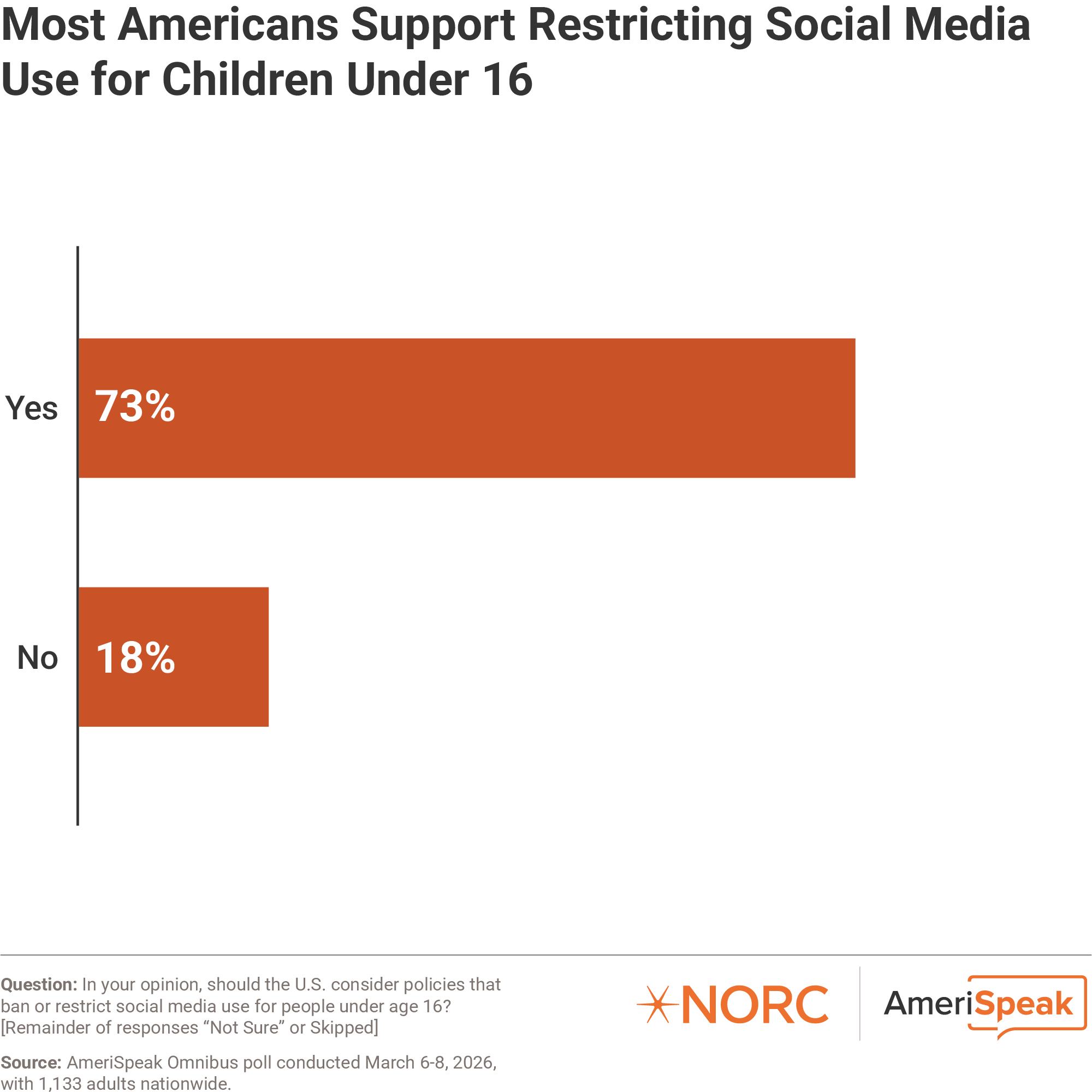
Most Americans Support Restricting Social Media Use for Children Under 16
As these debates gain momentum globally, Americans largely agree action may be warranted at home.
Most Americans support banning or restricting social media use for children under 16. Fewer than 1 in 5 oppose such a policy, underscoring the breadth of support behind efforts to limit youth access to social platforms.
Findings are drawn from our AmeriSpeak Omnibus survey, which offers a streamlined, cost-effective solution for obtaining high-quality, nationally representative data.
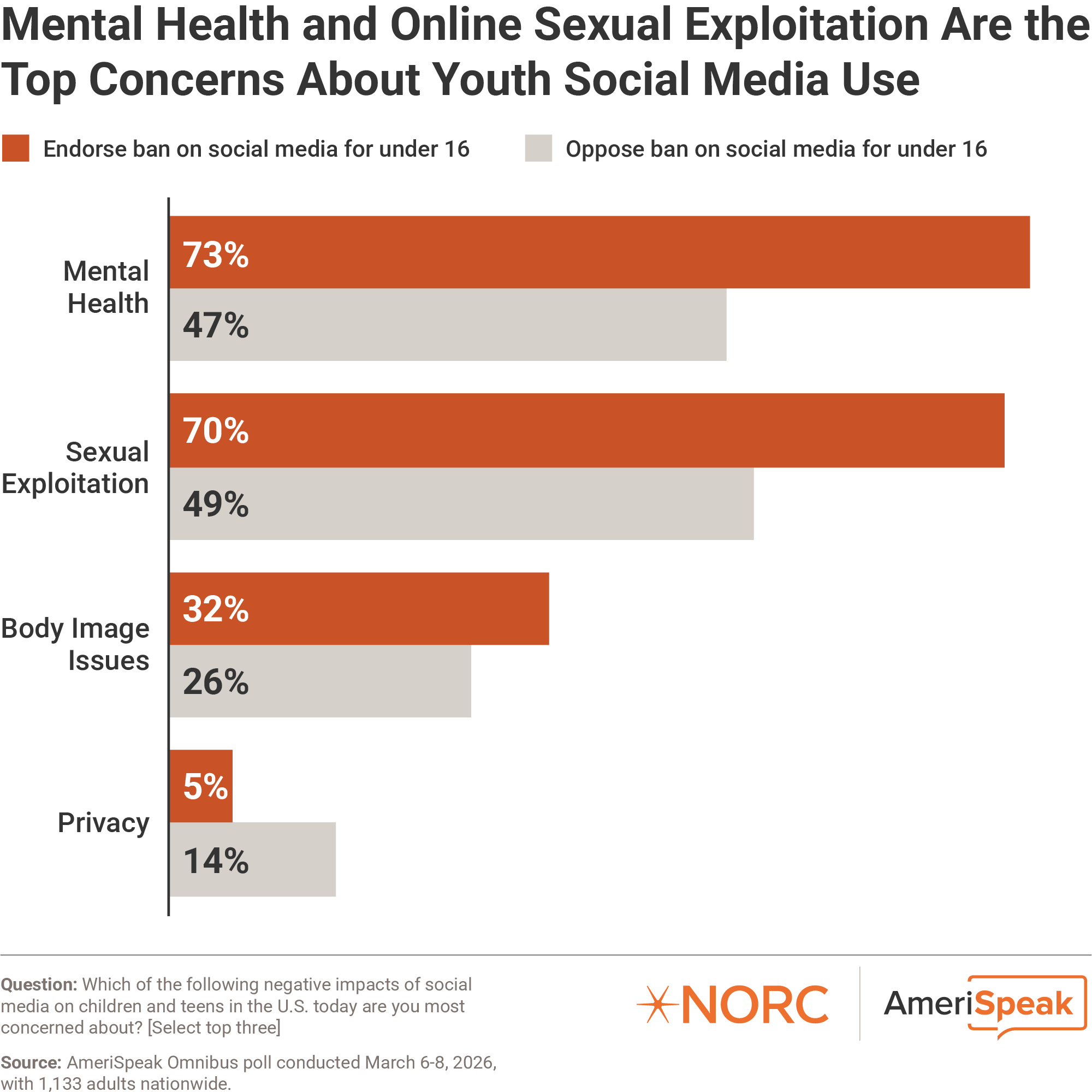
Mental Health and Online Sexual Exploitation Are the Top Concerns About Youth Social Media Use
Public concerns extend beyond screentime alone. Across the United States, Americans—particularly those who support a ban—most frequently cite concerns about youth mental health and online sexual exploitation when asked about the negative impacts of social media on children and teens.
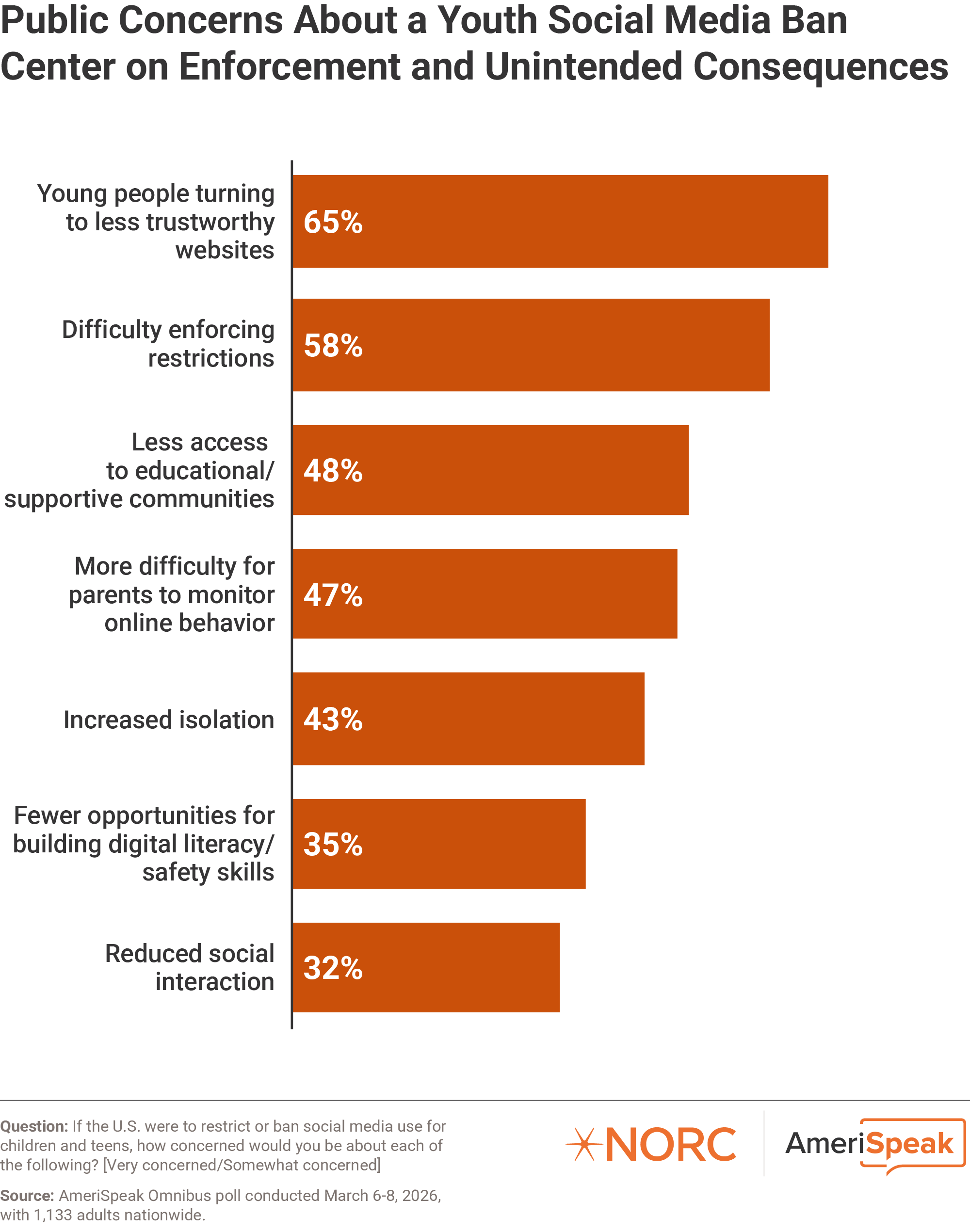
Public Concerns About a Youth Social Media Ban Center on Enforcement and Unintended Consequences
Even amid growing global momentum to restrict youth access to social media, public support isn’t unconditional. Americans are especially worried about:
- Young people turning to less trustworthy websites
- Difficulty enforcing restrictions
- Reduced access to supportive or educational online communities
Together, these concerns underscore the tension in public opinion: strong support for protecting minors online alongside widespread uncertainty about the effectiveness and downstream impacts of a ban.
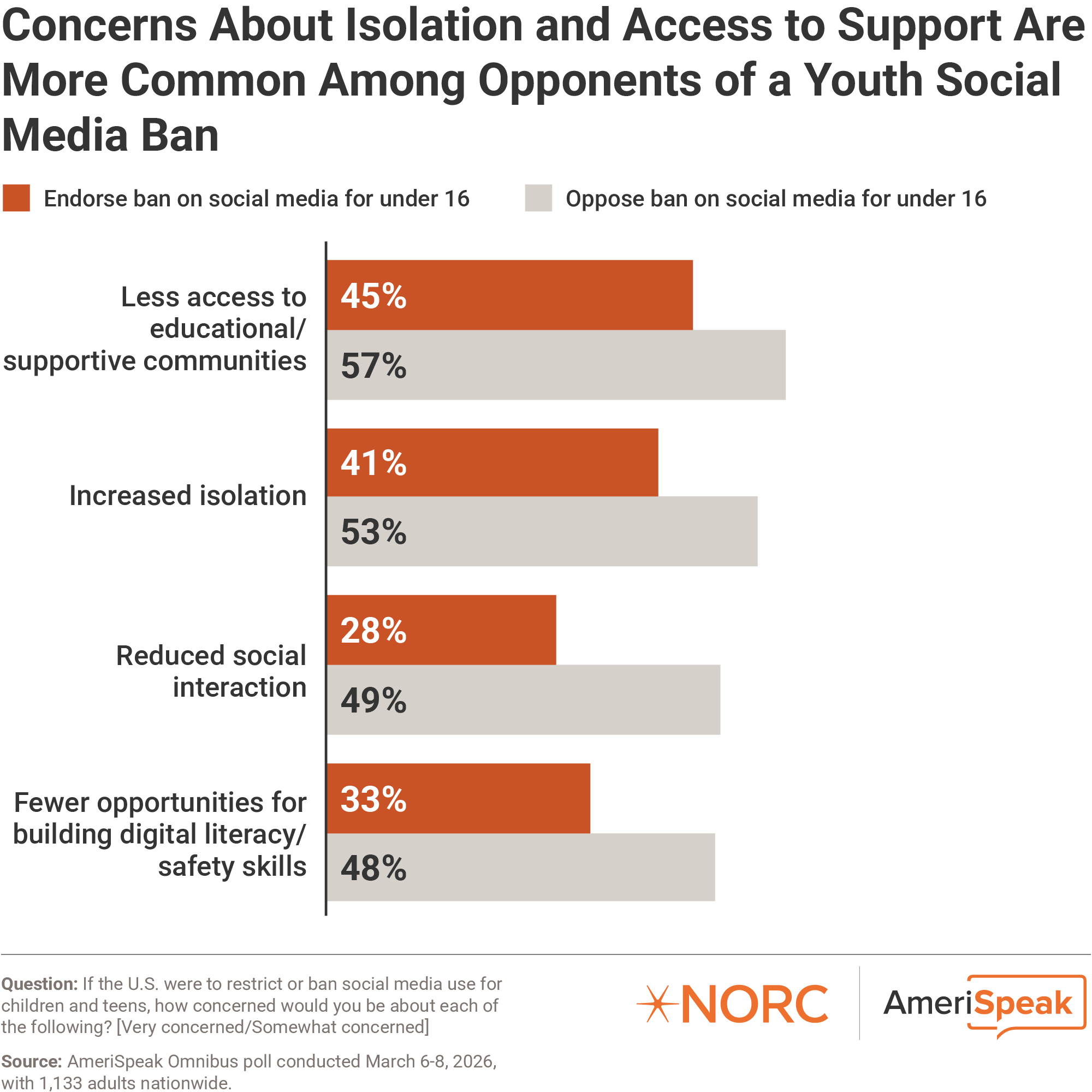
Concerns About Isolation and Access to Support Are More Common Among Opponents of a Youth Social Media Ban
As countries explore policies to limit social media use among children and teens, opposition is shaped largely by concerns about what young people might lose. In the United States, these worries are especially pronounced among Americans who oppose a youth social media ban.
Opponents are significantly more likely to cite concerns about increased isolation and reduced access to supportive or educational online communities. They also express more concern about diminished social interaction and fewer opportunities for youth to build digital literacy and safety skills—highlighting how resistance to a ban is closely tied to perceived tradeoffs.
Together, these findings show that Americans are largely aligned on the need to protect young people online, even as they remain divided on how best to do it. The tension between protection, access, and unintended consequences sits at the center of public opinion on restricting youth social media use.
Methodology
A poll of 1,133 American adults was conducted between March 6-8, 2026, using the AmeriSpeak® Omnibus, a bi-monthly multi-client survey using the AmeriSpeak panel, NORC’s probability-based panel that is designed to be representative of the U.S. household population. The margin of error is +/- 4.0 percentage points at the 95 percent confidence level, including the design effect. View the full methodology in the Transparency Report.
Findings are drawn from our AmeriSpeak Omnibus survey, which offers a streamlined, cost-effective solution for obtaining high-quality, nationally representative data. The Omnibus provides a nationally representative snapshot of U.S. adults, sourced directly from the AmeriSpeak panel. Households are selected randomly through NORC’s National Sample Frame, known for its industry-leading coverage. This frame encompasses over 97 percent of U.S. households, ensuring that all segments are well represented. AmeriSpeak goes the extra mile in recruitment, using a combination of U.S. mail notifications, NORC telephone interviewers, and in-person field staff.
Get in touch with our team and find out how our Omnibus—or any of our other survey options—can meet your research needs.
AmeriSpeak OmniBites
Bite-sized insights from the AmeriSpeak Omnibus. The Omnibus is a fast, affordable way to tap into nationally representative public opinion.
About AmeriSpeak
Funded and operated by NORC at the University of Chicago, AmeriSpeak® is a probability-based panel designed to be representative of the U.S. household population. Randomly selected U.S. households are sampled using area probability and address-based sampling, with a known, non-zero probability of selection from the NORC National Sample Frame. These sampled households are then contacted by U.S. mail, telephone, and field interviewers (face-to-face). The panel provides sample coverage of approximately 97 percent of the U.S. household population. Those excluded from the sample include people with P.O. Box only addresses, some addresses not listed in the USPS Delivery Sequence File, and some newly constructed dwellings. While most AmeriSpeak households participate in surveys by web, non-internet households can participate in AmeriSpeak surveys by telephone. Households without conventional internet access but having web access via smartphones are allowed to participate in AmeriSpeak surveys by web. AmeriSpeak panelists participate in NORC studies or studies conducted by NORC on behalf of governmental agencies, academic researchers, and media and commercial organizations.
For more information, email AmeriSpeak-BD@norc.org or visit AmeriSpeak.norc.org.
About NORC at the University of Chicago
NORC at the University of Chicago conducts research and analysis that decision-makers trust. As a nonpartisan research organization and a pioneer in measuring and understanding the world, we have studied almost every aspect of the human experience and every major news event for more than eight decades. Today, we partner with government, corporate, and nonprofit clients around the world to provide the objectivity and expertise necessary to inform the critical decisions facing society.
Contact: For more information, please email press@norc.org or call (877) 832-0392.


