
Americans’ Opinions of Gerrymandering Differ by Party Affiliation



Omnibites are bite-sized insights from the AmeriSpeak Omnibus, NORC’s fast, affordable way to tap into nationally representative public opinion.
April 2026
Survey gauges Americans’ familiarity, views on fairness, and priorities for drawing congressional districts.
As questions about representation, fairness, and electoral boundaries continue to surface across election cycles, gerrymandering remains a concept many Americans recognize—even as opinions about its impacts vary. Using data from the AmeriSpeak® Omnibus, a new survey explores how familiar Americans are with gerrymandering, how perceptions of fairness differ across demographic and geographic groups, and which principles the public believes should guide the drawing of legislative district boundaries.
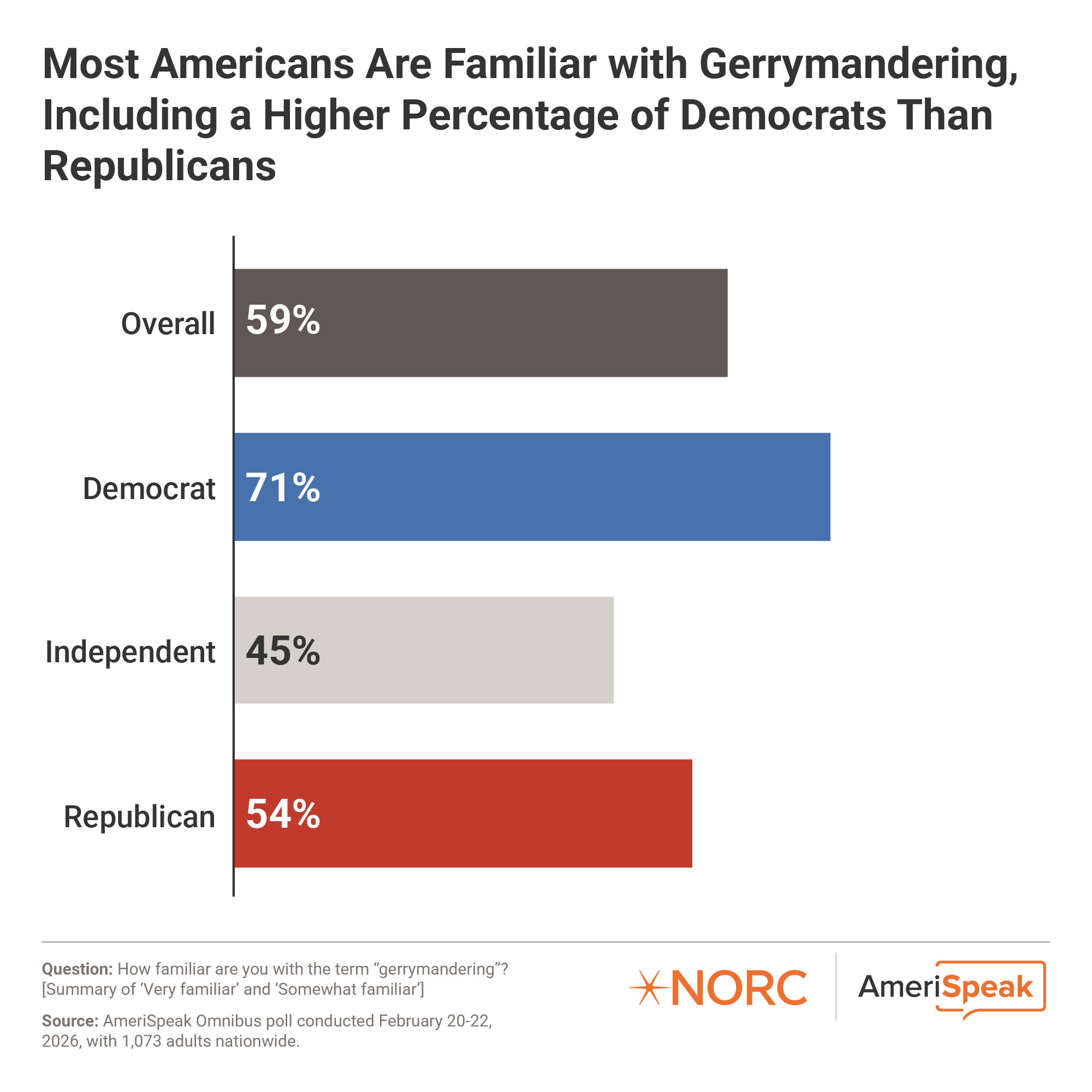
Most Americans Are Familiar with Gerrymandering, Including a Higher Percentage of Democrats Than Republicans.
In a year of critical midterm elections, most Americans are familiar with gerrymandering (the practice of drawing electoral district boundaries to give one political party or group an advantage), and most believe current congressional district boundaries are unfair.
- A higher percentage of Democrats than Republicans report familiarity with gerrymandering.
- Those who voted in 2024—across the political spectrum—are more likely than the general population to be familiar with the concept.
- Of those familiar with gerrymandering, most believe current boundaries are unfair, including a higher percentage of Democrats than Republicans.
Findings are drawn from our AmeriSpeak Omnibus survey, which offers a streamlined, cost-effective solution for obtaining high-quality, nationally representative data.
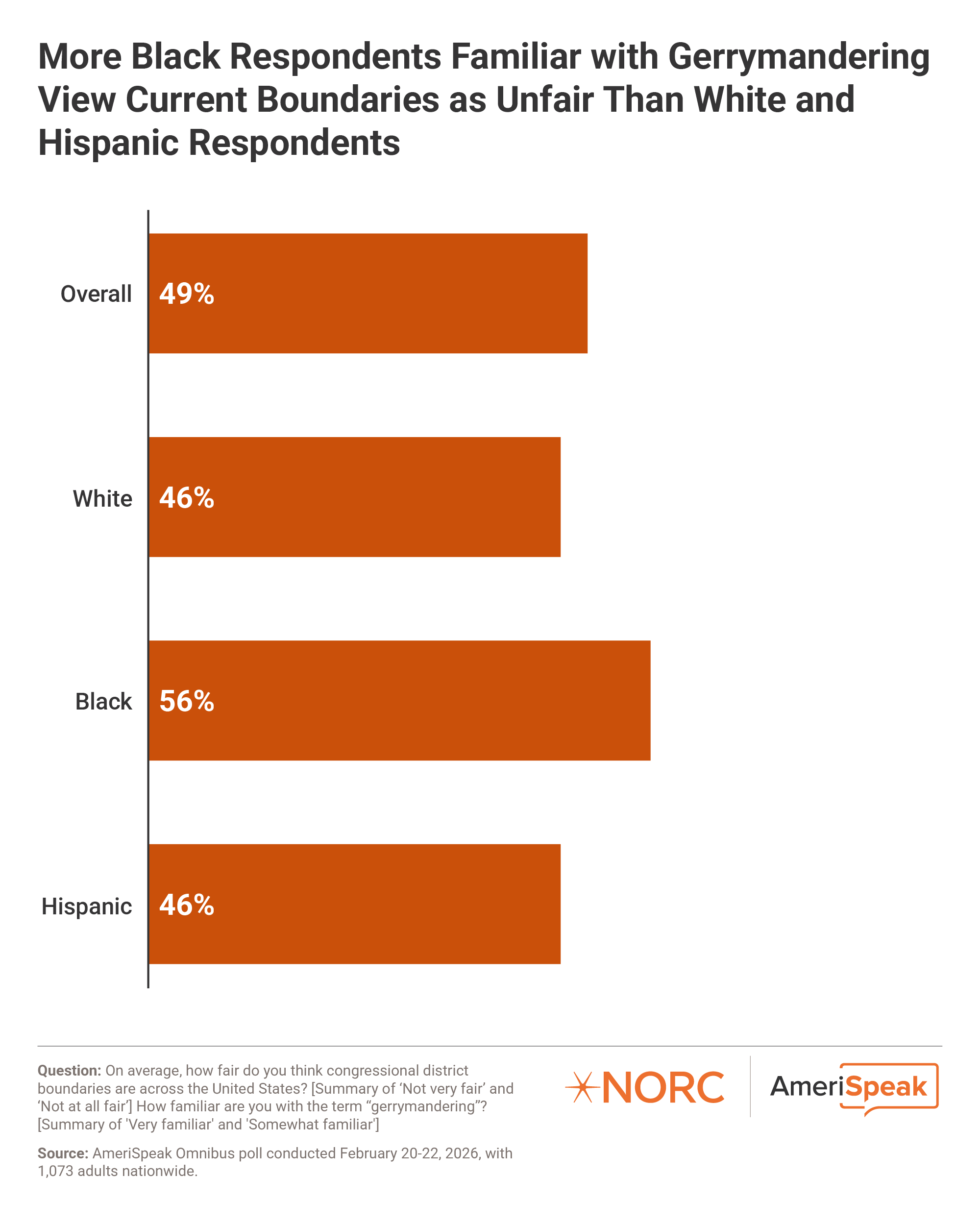
More Black Respondents Familiar with Gerrymandering View Current Boundaries as Unfair Than White and Hispanic Respondents
More Black Respondents Familiar with Gerrymandering View Current Boundaries as Unfair Than White and Hispanic Respondents
Americans’ views on the fairness of current congressional district boundaries may depend on race and state of residence.
Of those who report familiarity with gerrymandering, Black Americans are more likely than any other racial group to see the current boundaries as unfair.
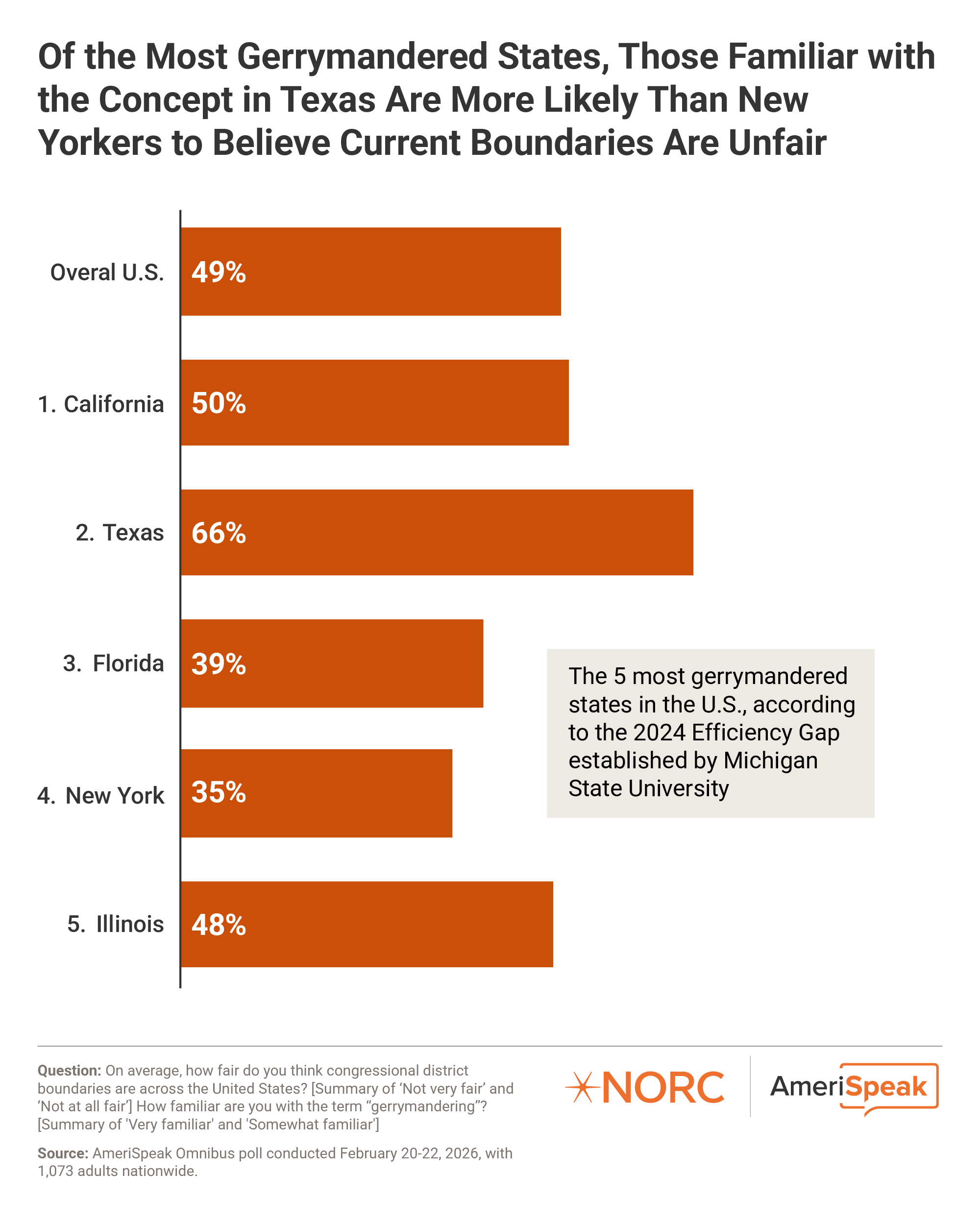
Of the Most Gerrymandered States, Those Familiar with the Concept in Texas Are More Likely Than New Yorkers to Believe Current Boundaries Are Unfair
Among the five most gerrymandered states (according to the 2024 Efficiency Gap established by Michigan State University), Texans familiar with the concept are most likely to view maps as unfair, almost twice as many as New Yorkers (66 to 35 percent).
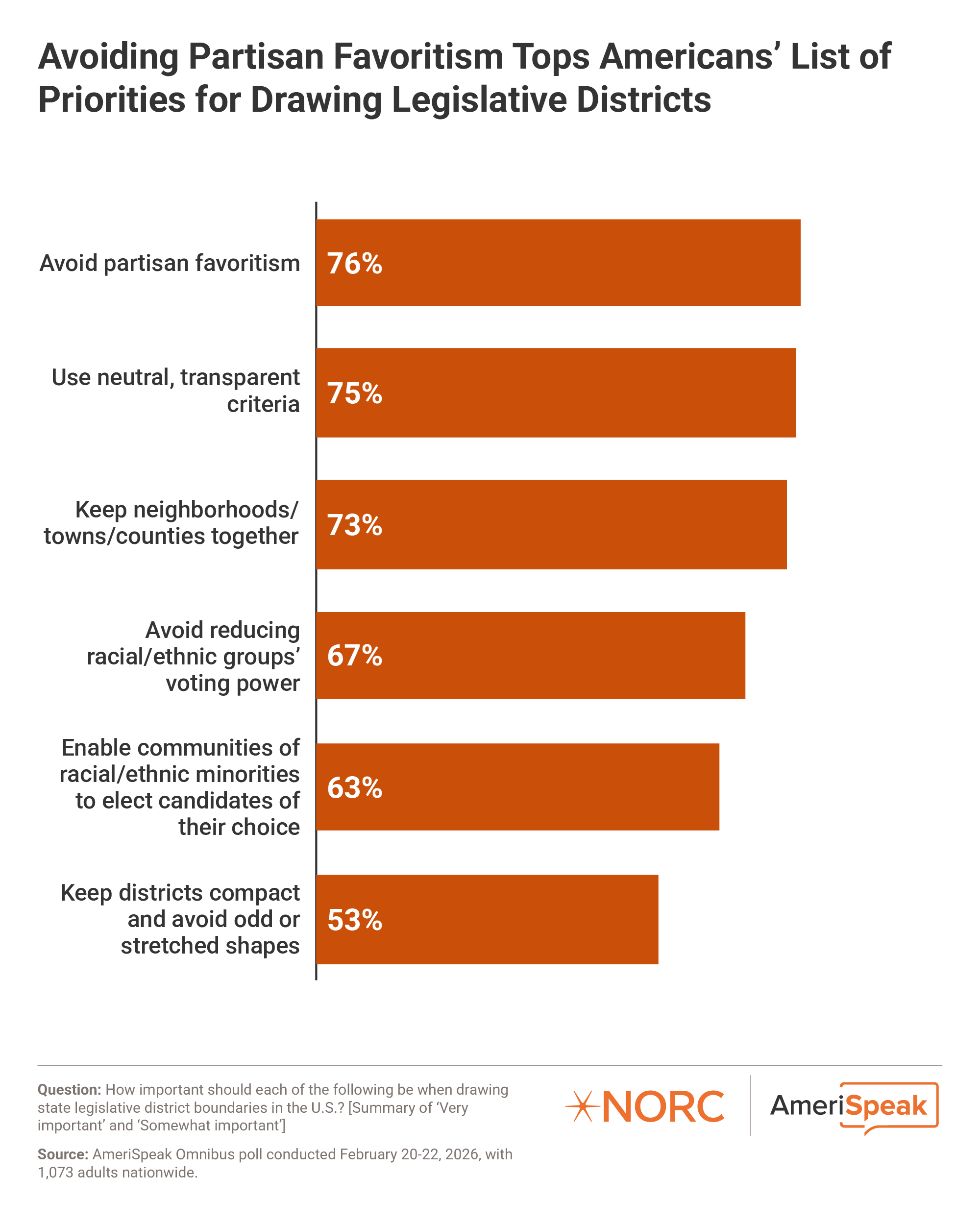
Avoiding Partisan Favoritism Tops Americans’ List of Priorities for Drawing Legislative Districts
When it comes to drawing legislative district boundaries, Americans overwhelmingly favor taking politics out of the process.
Avoiding partisan favoritism ranks as the top priority, followed closely by using neutral, transparent rules and keeping communities together. Taken together, the data point to a clear preference for common‑sense standards over political advantage in how maps are drawn.
These results suggest that awareness of gerrymandering is widespread, and that greater familiarity often coincides with heightened perceptions of unfairness. At the same time, Americans express broad agreement on the importance of neutral, transparent approaches to drawing district boundaries—highlighting shared priorities even amid differing views on how current maps perform.
Methodology
A poll of 1,073 American adults was conducted between February 20-22, 2026, using the AmeriSpeak® Omnibus, a bi-monthly multi-client survey using the AmeriSpeak panel, NORC’s probability-based panel that is designed to be representative of the U.S. household population. The margin of error is +/- 4.0 percentage points at the 95 percent confidence level, including the design effect. View the full methodology in the Transparency Report.
Findings are drawn from our AmeriSpeak Omnibus survey, which offers a streamlined, cost-effective solution for obtaining high-quality, nationally representative data. The Omnibus provides a nationally representative snapshot of U.S. adults, sourced directly from the AmeriSpeak panel. Households are selected randomly through NORC’s National Sample Frame, known for its industry-leading coverage. This frame encompasses over 97 percent of U.S. households, ensuring that all segments are well represented. AmeriSpeak goes the extra mile in recruitment, using a combination of U.S. mail notifications, NORC telephone interviewers, and in-person field staff.
Get in touch with our team and find out how our Omnibus—or any of our other survey options—can meet your research needs.
AmeriSpeak OmniBites
Bite-sized insights from the AmeriSpeak Omnibus. The Omnibus is a fast, affordable way to tap into nationally representative public opinion.
About AmeriSpeak
Funded and operated by NORC at the University of Chicago, AmeriSpeak® is a probability-based panel designed to be representative of the U.S. household population. Randomly selected U.S. households are sampled using area probability and address-based sampling, with a known, non-zero probability of selection from the NORC National Sample Frame. These sampled households are then contacted by U.S. mail, telephone, and field interviewers (face to face). The panel provides sample coverage of approximately 97 percent of the U.S. household population. Those excluded from the sample include people with P.O. Box only addresses, some addresses not listed in the USPS Delivery Sequence File, and some newly constructed dwellings. While most AmeriSpeak households participate in surveys by web, non-internet households can participate in AmeriSpeak surveys by telephone. Households without conventional internet access but having web access via smartphones are allowed to participate in AmeriSpeak surveys by web. AmeriSpeak panelists participate in NORC studies or studies conducted by NORC on behalf of governmental agencies, academic researchers, and media and commercial organizations.
For more information, email AmeriSpeak-BD@norc.org or visit AmeriSpeak.norc.org.
About NORC at the University of Chicago
NORC at the University of Chicago conducts research and analysis that decision-makers trust. As a nonpartisan research organization and a pioneer in measuring and understanding the world, we have studied almost every aspect of the human experience and every major news event for more than eight decades. Today, we partner with government, corporate, and nonprofit clients around the world to provide the objectivity and expertise necessary to inform the critical decisions facing society.
Contact: For more information, please email press@norc.org or call (877) 832-0392.


